

As an Amazon Associate I earn from qualifying purchases.
Understanding the Distinctions between Haitian Voodoo and Louisiana Voodoo
Cultural Origins
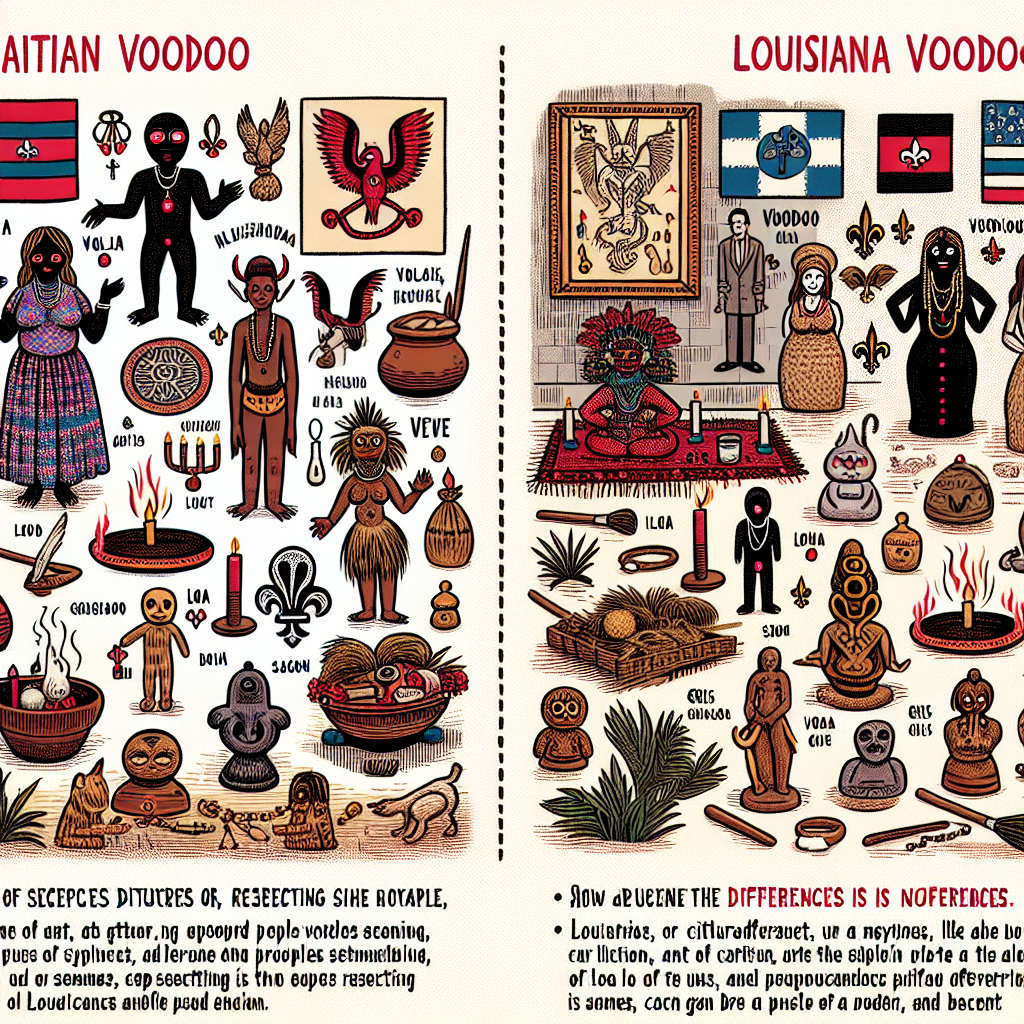
Haitian Voodoo and Louisiana Voodoo have distinct cultural origins. Haitian Voodoo is deeply rooted in the religious practices of West African slaves brought to Haiti, integrating elements of Catholicism during the colonial period. Contrastingly, Louisiana Voodoo emerged in the Southern United States, primarily in New Orleans, blending African, French, Spanish, and Native American spiritual traditions. The differences in origin significantly influence the rituals, deities, and overall practices in each tradition today.
Language Use
The languages used in rituals and ceremonies differ between Haitian Voodoo and Louisiana Voodoo. Haitian Voodoo commonly incorporates Haitian Creole and French. These languages not only reflect the country’s colonial history but also add layers of meaning to the religious practices. In Louisiana Voodoo, English and French are prevalent, reflecting the multicultural influences in the region. The choice of language can affect the incantations and the perceived power of the rituals.
Religious Structure
The hierarchical structure in these Voodoo practices varies. Haitian Voodoo features a more formal and organized hierarchy, with positions such as Houngan (priest), Mambo (priestess), and Bokor (sorcerer). This structure is often rigid and well-defined within communities. Louisiana Voodoo, however, tends to be less hierarchical. Leadership roles such as the Voodoo Queen exist, but the practice is more personalized and decentralized, contributing to its unique evolution.
Deities and Spirits
Deities and spirits play significant but different roles in each Voodoo tradition. Haitian Voodoo worships a pantheon of spirits known as Lwa, who act as intermediaries between humans and the Supreme Creator, Bondye. Each Lwa has a distinct personality and domain of influence. In Louisiana Voodoo, the spirits, often called Loa, share similarities with the Haitian Lwa but have incorporated other figures from Native American and early European settler traditions. This results in a more eclectic collection of spirits.
Ritual Practices
The ritual practices in Haitian and Louisiana Voodoo vary in style and execution. Haitian Voodoo rituals often involve elaborate ceremonies that can last for hours or even days, featuring drumming, dancing, and elaborate altars to honor the Lwa. Louisiana Voodoo rituals, while incorporating some of these elements, are typically shorter and may include elements such as gris-gris (amulets), herbal preparations, and practical magic spells. These differing practices reflect the distinct needs and influences of their respective communities.
Symbolism
Symbolism in Haitian Voodoo and Louisiana Voodoo also differs. Haitian Voodoo employs a rich tapestry of symbols, known as veves, which are intricate drawings representing different Lwa. These symbols are drawn on the ground using materials like cornmeal or powder during ceremonies. In contrast, Louisiana Voodoo symbolism often includes items such as crosses, small statues, or objects imbued with spiritual significance. The variance in symbolism underscores the differing religious and cultural influences on each tradition.
Music and Dance
Music and dance hold sacred importance in both traditions but with unique distinctions. Haitian Voodoo ceremonies feature complex percussion rhythms played on drums like the Rada and Petro, accompanied by specific dances that interact with the Lwa. The music and dance are deeply spiritual and serve to invite the spirits’ presence. Louisiana Voodoo also values music and dance, but it frequently incorporates local influences like blues and jazz into its rituals, reflecting New Orleans’ musical heritage and making these practices distinctly American.
Community Roles
In Haitian Voodoo, community roles are well-defined and integral to the religion’s function. The entire community often participates in ceremonies and plays a part in the spiritual life of the group. In Louisiana Voodoo, the community roles are more fluid. Although the Voodoo Queen or practitioner may lead rituals, much of the practice can be individualistic, with personal rituals and spells being a common element. This difference highlights the communal versus individualistic approaches of the two traditions.
Geographic Influence
Geography plays a significant role in shaping these Voodoo traditions. Haitian Voodoo remains predominantly practiced in Haiti and by the Haitian diaspora, maintaining a strong connection to its African roots and the Haitian landscape. Louisiana Voodoo, on the other hand, is most commonly associated with New Orleans, with its specific practices shaped by the region’s unique blend of cultures and its history of colonialism and migration. The geographic setting of each tradition impacts the evolution and adaptation of their practices.
Contemporary Perception
Contemporary perceptions of Haitian and Louisiana Voodoo differ widely, affected by media portrayals and socio-political factors. Haitian Voodoo often faces stigmatization and misunderstanding, both within Haiti and abroad, sometimes being misrepresented as malevolent. Louisiana Voodoo, popularized by its association with New Orleans, frequently enjoys a more mystical and commercialized depiction, especially during festivals like Mardi Gras. The divergent perceptions affect how each practice is respected and understood globally.
1. **Origins and Historical Context:**
The primary difference between Haitian Voodoo and Louisiana Voodoo lies in their origins and historical context. Haitian Voodoo emerged from the fusion of African traditions brought by enslaved people from West Africa, primarily the Fon, Yoruba, and Kongo tribes, with the Catholicism imposed by French colonists in Haiti. Louisiana Voodoo, on the other hand, evolved in the United States, specifically in the New Orleans area, influenced by the diverse mix of African, French, Spanish, and Native American cultures.
2. **Language of Rituals:**
In Haitian Voodoo, rituals are often conducted in Haitian Creole, which combines French with various African languages. This linguistic blend reflects the syncretic nature of the religion. Louisiana Voodoo rituals may feature English as well as French, but the presence of Haitian Creole is less predominant, demonstrating the distinct linguistic evolution within these spiritual practices.
3. **Deities and Spirits:**
Haitian Voodoo centers around the worship of the Loa (or Lwa), intermediary spirits who serve between humans and the Supreme Creator, Bondye. Each Loa has specific characteristics, preferences, and areas of influence. Louisiana Voodoo incorporates some of these spirits but also includes different entities, known as spirits or saints, reflecting a unique adaptation of Catholic saints and African deities.
4. **Practitioners and Specialists:**
In Haitian Voodoo, practitioners, known as Houngans (priests) or Mambos (priestesses), play critical roles in conducting rituals, ceremonies, and healing practices. Louisiana Voodoo practitioners include similar roles, such as Voodoo queens and priests, but the prominence of historical figures like Marie Laveau has given a distinct character to the priesthood in Louisiana Voodoo.
5. **Ritual Paraphernalia:**
The ritual paraphernalia used in Haitian Voodoo includes rituals with drums, feasts, and animal offerings to the Loa. Veves, intricate symbols drawn on the ground to invoke the Loa, are also crucial. In Louisiana Voodoo, while these elements are present, there is a greater emphasis on the use of gris-gris (charm bags), dolls, and potions, reflecting a different focus on tangible objects imbued with spiritual power.
6. **Festivals and Ceremonial occasions:**
Haitian Voodoo features large public ceremonies such as the Fête Ghede, dedicated to the spirits of the dead, and significant celebrations during the summer months. Louisiana Voodoo, however, often intertwines with the broader cultural festivities of New Orleans, including Mardi Gras and St. John’s Eve ceremonies, which often include Voodoo elements.
7. **Place of Worship:**
In Haiti, Voodoo temples, known as hounfours, are where most rituals and ceremonies take place, often acting as community centers. In Louisiana Voodoo, rituals might take place in more informal settings, ranging from private homes to community spaces, reflecting a more decentralized practice often influenced by local customs and environments.
8. **Legal Status and Perception:**
Haitian Voodoo holds a legally recognized status in Haiti, with its own temples and clergy. It is an integral part of Haitian culture and societal structure. By contrast, Louisiana Voodoo, while culturally significant, does not enjoy the same level of formal recognition and often contends with stereotypes and misconceptions within the broader American context.
9. **Role of Catholicism:**
While both Haitian Voodoo and Louisiana Voodoo have integrated elements of Catholicism, the degree and manner of this integration differ. Haitian Voodoo more seamlessly blends Catholic saints with Loa, reflecting centuries of syncretism. In Louisiana Voodoo, the Catholic influence is evident but may manifest separately or as a parallel practice, reflecting local variations in religious syncretism.
10. **Public Perception and Tourism:**
Haitian Voodoo has a somewhat more insular reputation, primarily practiced within the Haitian community and valued for its cultural and historical significance. Louisiana Voodoo, particularly in New Orleans, has a public-facing aspect that is often commodified for tourism, with shops, tours, and festivals promoting an accessible, if sometimes commercialized, view of the religion.
According to the Pew Research Center, about 6% of adults in Haiti identify Voodoo as their primary religion, illustrating its continued importance in Haitian culture.
u003ch2u003ePractices and Ritualsu003c/h2u003e
u003cpu003eIn my experience, one of the most striking differences between Haitian Voodoo and Louisiana Voodoo lies in their rituals and practices. Haitian Voodoo rituals often have a more communal focus, involving entire villages where every participant has a designated role. I remember attending a Haitian Voodoo ceremony where people gathered around a central pillar, a representation of the poto-mitan, the axis of the world. The energy was electric as drummers, dancers, and singers worked in unison to call upon the spirits, or lwa.u003c/pu003e
u003cpu003eLouisiana Voodoo, on the other hand, incorporates a higher degree of individualism, particularly due to its syncretic nature. When I had the opportunity to attend a Louisiana Voodoo ritual, I noticed that it was often led by a single practitioner, usually a Voodoo Queen or King. The focus was usually on specific rituals or spells, aimed at personal goals such as love, protection, or vengeance. It felt more like a bespoke service than a communal rite, emphasizing the individual rather than the collective.u003c/pu003e
u003cpu003eFood offerings also differ between these two traditions. While both types may offer food to the spirits, Haitian Voodoo often includes communal feasting as a central part of the ritual. I saw how everyone shared a meal after the ceremony, a sign of unity and community. In contrast, Louisiana Voodoo offerings appeared to be more symbolic, often left at gravesites or altars and rarely consumed by the participants.u003c/pu003e
u003ch2u003eSpiritual Hierarchyu003c/h2u003e
u003cpu003eThe hierarchy within Haitian Voodoo and Louisiana Voodoo also presents notable distinctions. In Haiti, the hierarchical structure is quite clear, featuring a pantheon of lwa who interact with humans through a well-defined system of houngans (priests) and mambos (priestesses). I remember how houngans and mambos were deeply respected figures, almost like local celebrities. Their influence extended well beyond spiritual matters, often affecting social and political spheres.u003c/pu003e
u003cpu003eLouisiana Voodoo, however, tends to be less hierarchical. The presence of a single, powerful Voodoo Queen or King often overshadows the collective body of practitioners. When I visited New Orleans, the legacy of famous Voodoo Queens like Marie Laveau was palpable; people spoke of her with a mix of reverence and awe. This tradition allows for highly charismatic leaders to gain significant influence, sometimes resembling the individualistic nature of celebrity culture more than a structured religious hierarchy.u003c/pu003e
u003cpu003eAnother point of distinction is the role of spirits outside the primary pantheon. In Haitian Voodoo, the spirits (lwa) play a central role, and each ritual typically calls upon a specific lwa to intervene. However, in Louisiana Voodoo, the practice often includes the veneration of other spirits, including those of local historical figures. When talking to locals, I was fascinated to learn how people incorporated spirits of well-known characters into their practices, blending historical reverence with spiritual invocation.u003c/pu003e
u003ch2u003eLanguage and Chantingu003c/h2u003e
u003cpu003eOne of the first differences I noticed when comparing Haitian Voodoo and Louisiana Voodoo is the language used in ceremonies and chants. Haitian Voodoo primarily uses Haitian Creole, a blend of French and West African languages. When I participated in a Haitian ceremony, the chanting and songs were in Creole, rich with historical depth and cultural nuance. Understanding even a little bit of Creole enriched the experience, making the chants feel more potent and meaningful.u003c/pu003e
u003cpu003eLouisiana Voodoo, by contrast, includes a mix of English, Creole, and African languages. It’s more of a linguistic patchwork, reflective of its diverse historical influences. During a New Orleans ceremony, I noticed that English was frequently used, especially during moments where inclusivity and comprehensibility were crucial. This made Louisiana Voodoo ceremonies more accessible to outsiders and tourists, yet it also made the chants seem less rooted in a single, ancient tradition compared to their Haitian counterparts.u003c/pu003e
u003cpu003eThe rhythm and style of chanting also vary between these two forms of Voodoo. In Haiti, the chants and songs often carry a distinctly African rhythm that has been preserved through generations. In Louisiana, the influence of jazz and blues is apparent even in rituals, creating a melodious but distinctly different atmosphere. The chants in Louisiana Voodoo felt more freeform, almost like a jam session, compared to the structured and ancient-feeling chants in Haitian Voodoo.u003c/pu003e
u003ch2u003eSymbols and Sacred Objectsu003c/h2u003e
u003cpu003eSymbols and sacred objects hold crucial importance in both Haitian and Louisiana Voodoo, yet they manifest quite differently. In Haitian Voodoo, one of the most fundamental symbols is the vévé, an intricate design drawn on the ground to invoke lwa. I watched practitioners meticulously draw these symbols using cornmeal or ash, a process that felt both ceremonial and deeply spiritual. These vévés are specific to each lwa and serve as their spiritual signatures.u003c/pu003e
u003cpu003eLouisiana Voodoo employs a different array of symbols and sacred objects. While vévés might still be used, I observed a stronger emphasis on gris-gris bags (talismanic objects) and Voodoo dolls. The dolls, in particular, intrigue many outsiders, often to the point of overshadowing other aspects of the religion. It was eye-opening to see how these dolls were actually used; far from the sinister caricatures often portrayed in media, they served as focal points for prayer and intention.u003c/pu003e
u003cpu003eAltars also reflect these differences. Haitian altars are typically elaborate setups featuring images of Catholic saints, offerings, and a central cross, symbolizing the merging of African spirituality with Catholicism. Louisiana Voodoo altars, while similar, often incorporate personal items or artifacts tied to local history and culture. One altar I saw included objects like jazz records and trinkets that spoke to the unique heritage of New Orleans, showing how the practice adapts to its environment.u003c/pu003e
“`html
FAQs
What are the primary differences between Haitian Voodoo and Louisiana Voodoo?
Haitian Voodoo and Louisiana Voodoo differ mainly in their ritual practices, language, and spiritual entities. Haitian Voodoo incorporates French and African languages, while Louisiana Voodoo is influenced by French Creole. Additionally, each tradition has unique ceremonies and deities.
Is Voodoo considered a religion?
Yes, both Haitian Voodoo and Louisiana Voodoo are recognized as legitimate religions, each with its own set of beliefs, rituals, and spiritual practices rooted in African traditions.
How did African traditions influence Haitian and Louisiana Voodoo?
African traditions were brought over by enslaved Africans and fused with Native American and European elements, creating a unique syncretism in both Haitian and Louisiana Voodoo.
Are the spiritual entities in Haitian Voodoo and Louisiana Voodoo the same?
While there are similarities, each tradition has its own set of spiritual entities known as Loa in Haitian Voodoo and as spirits in Louisiana Voodoo. Some deities overlap, but others are unique to each tradition.
What role do languages play in these Voodoo practices?
Language plays a significant role. Haitian Voodoo often uses Haitian Creole and French, while Louisiana Voodoo predominantly uses English mixed with French Creole. The choice of language can influence the rituals and chants employed in ceremonies.
Are the rituals and ceremonies in Haitian Voodoo and Louisiana Voodoo similar?
There are some similarities such as the use of altars, candles, and symbols, but the rituals and ceremonies are distinct in many ways due to cultural and regional differences.
Do both Haitian and Louisiana Voodoo practitioners use Voodoo dolls?
Voodoo dolls are more commonly associated with Louisiana Voodoo and are used as tools for various purposes. In Haitian Voodoo, dolls are less prominent and rituals focus more on direct spiritual communication.
What is the role of a priest or priestess in Voodoo?
In both Haitian and Louisiana Voodoo, priests (Houngans) and priestesses (Mambos) serve as spiritual leaders, conducting rituals and ceremonies, and acting as intermediaries between the spiritual world and the community.
How do these Voodoo traditions perceive the concept of magic?
Both traditions view magic as a practical and spiritual tool to interact with the spiritual realm and affect the physical world. However, the methods and intentions behind magic can differ based on cultural practices and beliefs.
Is there a moral code or ethical guideline in Voodoo?
Yes, both Haitian and Louisiana Voodoo have ethical guidelines often tied to respect for the spirits, community, and nature. Morality is deeply embedded in the interactions and relationships within the community and with the spiritual realm.
“`
## Conclusion
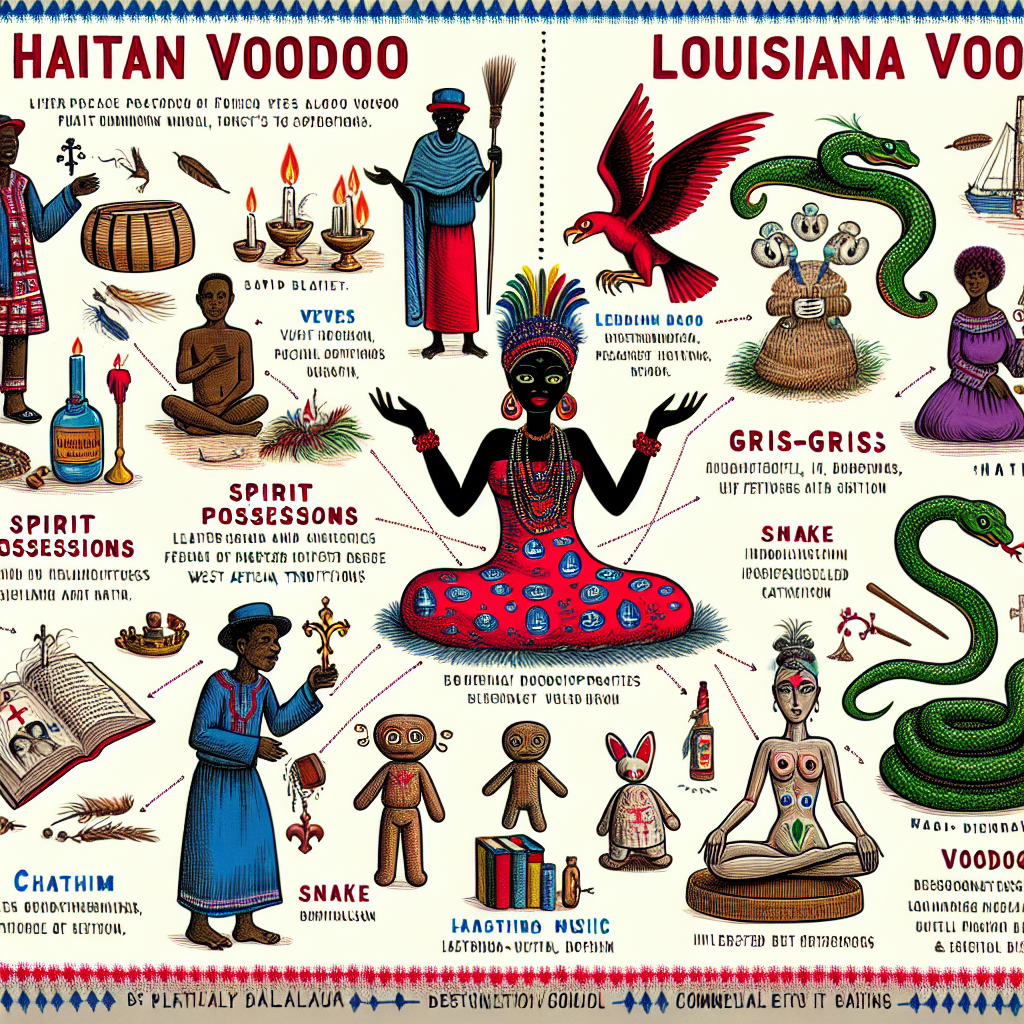
Haitian Voodoo and Louisiana Voodoo, though often conflated, reveal distinct differences in their spiritual practices, African traditional roots, and societal roles. Haitian Voodoo has a deep connection to its African heritage, particularly from the Fon and Kongo peoples, and retains a more homogenized practice involving a structured pantheon of spirits called Loa. Rituals in Haitian Voodoo are highly community-centric, often involving elaborate ceremonies that engage entire communities in music, dance, and sacrificial offerings to commune with these spirits. In contrast, Louisiana Voodoo, influenced by African, Native American, and European traditions, exhibits a more syncretic and individualized form. It often involves the use of gris-gris (amulets), hoodoo (folk magic practices), and the worship of saints alongside African deities, reflecting its adaptation to the cultural melting pot of New Orleans.
Another essential difference emerges in the functions and perception of spiritual leaders. In Haitian Voodoo, the priests (houngans) and priestesses (mambos) play pivotal roles in maintaining spiritual order, conducting rituals, and acting as intermediaries between the divine and the community. Alternatively, in Louisiana Voodoo, figures like the Voodoo Queen—exemplified by the iconic Marie Laveau—serve not only as spiritual leaders but also cultural icons with political and social influence. These multifaceted roles underscore the religion’s adaptability and its embeddedness within the broader cultural tapestry of Louisiana. Both traditions underscore a profound resilience and adaptability, highlighting the dynamic, evolving nature of African diasporic spiritual practices in the Americas.
Amazon and the Amazon logo are trademarks of Amazon.com, Inc, or its affiliates.
Continue Your Magical Journey
Free Witchcraft Starter Kit
Get 6 free printable PDFs: grimoire pages, moon calendar, spells, crystals, herbs, and tarot journal.
We respect your privacy. Unsubscribe anytime.
Enhance Your Practice
As an Amazon Associate, I earn from qualifying purchases.