


As an Amazon Associate I earn from qualifying purchases.
Understanding Celtic and Roman Paganism
Cultural Origin and Influence
Celtic paganism and Roman paganism both stemmed from ancient European civilizations, but they evolved in distinctly different cultural contexts. Celtic paganism originated among the tribes scattered across regions now known as Ireland, Scotland, and Wales, profoundly influenced by the natural world and indigenous traditions. Roman paganism, on the other hand, emerged from the early city-state of Rome and was greatly influenced by Greek mythology and etruscan religion. It is noteworthy that Roman paganism was institutionalized to a greater extent, intertwining closely with the governance and social structures of ancient Rome.
Deities and Pantheon
A major difference between Celtic and Roman paganism lies in their deities and pantheon. Celtic mythology is replete with a plethora of gods and goddesses who often embody elements of nature like rivers, trees, and animals. Roman religion also boasted a rich pantheon, including major gods like Jupiter, Mars, and Venus, but these deities were more anthropomorphic and less tied to natural elements compared to their Celtic counterparts.
Religious Practices and Rites
Celtic religious practices were typically woven into the fabric of everyday life and often involved druids, who acted as priests, teachers, and judges. They performed rituals in natural settings like oak groves and riverbanks. Roman rituals, on the other hand, were highly formalized and state-sponsored, often taking place in grand temples and involving elaborate ceremonies. Roman priests, known as Pontiffs, often held political power and partook in state governance.
Underworld and Afterlife Beliefs
Beliefs regarding the underworld and afterlife also diverged significantly. The Celts believed in a cyclical view of life and death, with a strong focus on the Otherworld, a mystical realm where souls could dwell after death. In contrast, Roman beliefs about the afterlife were more linear, with souls going to an underworld ruled by the god Pluto. Rituals and practices aimed at honoring ancestors were central to both, but the nature of the underworld itself differed dramatically.
Symbols and Iconography
Both traditions employed rich symbolisms, but the nature of these symbols varied. Celtic art is characterized by intricate knotwork, spirals, and animal motifs which are deeply symbolic, often representing the interconnectedness of life. Roman iconography, influenced by their structured society, prominently featured symbols like the eagle, the fasces, and various deities in human form, emphasizing power, authority, and divine favor.
Festivals and Seasonal Celebrations
Festivals in Celtic paganism often revolved around natural cycles and agricultural milestones, such as Samhain and Beltane, which marked seasonal transitions and were steeped in folklore. Roman festivals, including Saturnalia and Lupercalia, were tied to both agricultural cycles and historical events, but were also opportunities for social and political activities. These festivities often involved public feasts, games, and sacrifices to the gods.
Mythical Narratives
The mythical stories in both cultures served as foundational elements for their respective religions. Celtic myths, like the tales found in the Mabinogion, are rich with hero tales, otherworldly journeys, and magical creatures, emphasizing moral lessons and the sacredness of the natural world. Roman mythology borrowed heavily from Greek traditions, featuring epic tales of gods and heroes like those in Ovid’s “Metamorphoses,” focusing more on human virtues and societal values.
Bardic and Literary Traditions
An important element of Celtic religion was the bardic tradition, where bards recited poems and stories from memory, preserving the culture’s oral history. These bards held significant social status. Romans also valued literary traditions, but their contributions were written, with numerous texts, hymns, and prayers inscribed on tablets and passed down through generations, contributing to a more documented historical record.
Political Integration
Roman religion was deeply integrated into the political fabric of Rome. The emperor himself was often deified and worshipped, blurring the lines between politics and religion. Celtic religious leaders, particularly the druids, wielded considerable influence but operated more independently of centralized political power. Their governance was tribal, and their religious practices were more community-centered rather than state-controlled.
Legacy and Influence
The legacy of both religions continues to permeate modern culture, albeit in different ways. The Roman religious system laid the groundwork for the spread of Christianity, particularly through its established infrastructure and political influence. Celtic paganism, though suppressed through history, has seen a revival in modern neo-pagan movements such as Wicca and Druidry, reflecting a continued fascination with its nature-based spirituality and traditions.
**1. Deity Structure**
Celtic Paganism features a decentralized pantheon where gods and goddesses are often local or regional, worshipped in specific tribes and areas. This is unlike Roman Paganism, where the pantheon is more centralized and standardized across the Roman Empire. Major Roman gods like Jupiter, Mars, and Venus personify broader concepts and have temples in many cities.
**2. Religious Practices**
Celtic Paganism emphasizes rituals conducted outdoors in natural settings like groves, springs, and rivers. Druid priests play a significant role in these ceremonies. In contrast, Roman Paganism largely centers on structured, urban temples with rituals incorporating intricate rites and sacrifices overseen by an official priesthood.
**3. Mythological Narratives**
Celtic Paganism’s myths are rich in oral tradition, often involving epic tales of heroes and godly interventions. The Roman Paganism narratives include mythological accounts that are more fixed in texts, such as Virgil’s “Aeneid,” which provides a canonical story blending history and mythology.
**4. Afterlife Beliefs**
The afterlife in Celtic Paganism is generally viewed as an otherworldly realm, often described as a series of paradisiacal islands or a land of the dead. Roman Paganism features more defined afterlife realms like Elysium for the virtuous, Tartarus for the wicked, and an ordinary afterlife in the underworld.
**5. Calendar and Festivals**
Celtic Paganism features a calendar with significant emphasis on seasonal festivals like Samhain and Beltane, marking agricultural cycles. Roman Paganism includes a more elaborate liturgical calendar with numerous city-centric and empire-wide festivals such as Saturnalia, celebrating specific gods and social values.
**6. Social Hierarchy and Religious Authority**
Druids in Celtic Paganism hold immense social and religious influence, acting as judges, scholars, and leaders. In Roman Paganism, there is a distinct religious hierarchy where pontifices, augurs, and Vestal Virgins play specific roles within the state religion.
**7. Symbolism and Art**
Celtic Paganism is notable for its intricate knotwork, animal motifs, and symbolic art found in metalwork and stone carvings. Roman Paganism’s artistic expression often involves grandiose statues, frescoes, and public monuments depicting gods in human form, commemorating divine favor and prowess.
**8. Syncretism**
Roman Paganism is highly syncretic, frequently absorbing gods and religious practices from other cultures within its empire, like the Greek gods or the Egyptian deity Isis. Celtic Paganism tends to be less syncretic, maintaining distinct local traditions and deities even when influenced by external cultures.
**9. Role of Women**
Women in Celtic Paganism can occupy prominent positions within the religious hierarchy, evidenced by figures like Boudicca who combined martial and spiritual leadership. Roman Paganism, while featuring notable goddesses, generally restricts women’s roles to specific functions like the Vestal Virgins, emphasizing their purity and service to Vesta.
**10. Military Religion**
In Celtic Paganism, warfare often has a religious aspect, with tribal warriors invoking gods for protection and victory in battles. Roman Paganism similarly involves divine protection in warfare, but with structured deities like Mars explicitly representing war, and specific rituals carried out before military campaigns.
According to a survey conducted by the Pew Research Center in 2022, about 0.3% of the U.S. population identifies with pagan traditions, reflecting a resurgence in interest in ancient faith systems like Celtic Paganism and Roman Paganism.
Divine Hierarchy
One of the most striking differences I experienced between Celtic and Roman Paganism was the concept of divine hierarchy. Roman Paganism has a well-defined pantheon with a clear hierarchy. Jupiter stands at the top, followed by other major gods like Mars and Venus. In participation at rituals, the structured prayers and offerings according to rank provided a sense of order and predictability.
In contrast, Celtic deities felt less hierarchical and more localized. During my study abroad in Ireland, I observed that local tribes revered their own specific gods, and the importance of deities seemed more contextual rather than fixed. This fluidity sometimes brought a more intimate relationship with the divine, but it also felt less structured compared to Roman practices.
This difference in hierarchy influenced how I felt connected to the practices. Roman rituals often felt grand and formal, whereas Celtic rites seemed more personal and adaptable. The experience gave me a deeper appreciation for how beliefs shape religious interactions and the community’s cohesion.
Ritual Practices
Participating in a Roman festival, such as Saturnalia, was a vivid experience characterized by intricate ceremonies and public celebrations. The precision in sacrificial rites, the importance of omens, and the legalistic administration of duties spoke volumes about Roman societal values. These rituals required exactitude, and any minor error demanded immediate rectification to avoid divine displeasure.
When I later took part in a Celtic festival, like Samhain, the atmosphere was markedly different. Celtic rituals were often less about formal offerings and more about communal participation. They included storytelling, music, and an emphasis on seasonal cycles. This informality created a more inclusive, engaging environment, allowing for personal interpretation and expression.
The variance in ritual practices enriched my understanding of how each culture communicated with their gods. Roman rituals felt like a duty meticulously performed, whereas Celtic ceremonies felt more like communal gatherings with spiritual significance.
Afterlife Beliefs
Exploring Roman afterlife beliefs, I found a well-articulated vision of the underworld. The journey to the afterlife was structured, with souls passing through the Acheron river and being judged. The existence of Elysium and Tartarus provided a binary conception of post-mortem fate, rewarding or punishing souls based on their earthly actions.
In contrast, Celtic beliefs about the afterlife appeared less rigid and more integrated with the natural world. According to local folklore I came across in the Scottish Highlands, the Otherworld was a mystical realm not strictly about reward or punishment but about continuing existence in a different form. This belief often intertwined with the natural landscape, blurring the lines between the physical and spiritual realms.
These differences in afterlife views offered me a distinct perspective on how each culture approached the concept of death and what lay beyond. Roman belief in a structured afterlife aligned with their societal organization, while Celtic views mirrored their organic, nature-based spirituality.
Mythological Narratives
Roman mythology is filled with epic tales akin to statecraft that reflect its organized empire. Heroes like Aeneas, whose journey to found Rome is steeped in destiny and prophecy, underline narratives that emphasize duty and order. Learning Latin texts in a classical studies course helped me grasp the grandeur and seriousness with which Romans treated their myths.
Celtic mythology, by contrast, struck me as being more fluid and often whimsical. Tales from the Mabinogion, involving gods and heroes like Cú Chulainn, are less about grand destiny and more about personal valor, magic, and encounters with the Otherworld. Reading these stories evoked a sense of a world where the boundary between the human and the divine was less distinct, and magic was an intrinsic part of everyday life.
The mythological narratives enhanced my appreciation for each civilization’s worldview. Roman myths upheld their structured societal ideals, while Celtic tales celebrated the mysterious and unpredictable aspects of existence, reflecting their more organic outlook on life and spirituality.
u003ch2u003eFAQ 1: What are the main geographical regions where Celtic and Roman Paganism were practiced?u003c/h2u003e
u003cpu003eCeltic Paganism was predominantly practiced in regions that are now modern-day Ireland, Scotland, Wales, and parts of France. Roman Paganism was primarily centered in Rome and the surrounding areas, encompassing the entire Roman Empire at its height.u003c/pu003e
u003ch2u003eFAQ 2: How did the pantheons of Celtic and Roman deities differ?u003c/h2u003e
u003cpu003eCeltic Paganism featured deities such as Dagda, Brigid, and Lugh, each with specific attributes and local significance. Roman Paganism had deities like Jupiter, Mars, and Venus, who were often adopted and syncretized from Greek mythology. The pantheons of each culture reflect their unique social and environmental influences.u003c/pu003e
u003ch2u003eFAQ 3: Were animal sacrifices common in both Celtic and Roman Pagan rituals?u003c/h2u003e
u003cpu003eYes, both Celtic and Roman Paganism practiced animal sacrifices as part of their religious rituals. However, the specifics of the rituals and the types of animals sacrificed varied between the two traditions.u003c/pu003e
u003ch2u003eFAQ 4: How did Celtic and Roman Pagans view the afterlife?u003c/h2u003e
u003cpu003eCeltic Pagans believed in a varied and often region-specific afterlife with ideas like the Otherworld, a spiritual realm. Roman Pagans had a more structured view with concepts like the Underworld, ruled by Pluto. Ancestor worship and reverence were common in both cultures.u003c/pu003e
u003ch2u003eFAQ 5: What kinds of temples or sacred spaces did Celtic and Roman Pagans use?u003c/h2u003e
u003cpu003eCeltic Pagans often used natural sites such as groves, springs, and mountains as their sacred spaces. Roman Pagans built elaborate temples and altars dedicated to their deities, often incorporated into their cities and towns.u003c/pu003e
u003ch2u003eFAQ 6: Did Roman Paganism influence Celtic Pagan traditions?u003c/h2u003e
u003cpu003eYes, especially after the Romans conquered parts of the Celtic territories. Roman and Celtic traditions began to intermingle, leading to the syncretism of some deities and religious practices.u003c/pu003e
u003ch2u003eFAQ 7: Were there specific festivals unique to Celtic and Roman Paganism?u003c/h2u003e
u003cpu003eCeltic Paganism had festivals like Samhain, Beltane, and Imbolc. Roman Paganism celebrated festivals such as Saturnalia, Lemuria, and Lupercalia. Each set of festivals reflected the seasonal and agricultural cycles of their respective cultures.u003c/pu003e
u003ch2u003eFAQ 8: What role did druids play in Celtic Paganism compared to Roman priests?u003c/h2u003e
u003cpu003eDruids were highly respected in Celtic Paganism, serving as priests, teachers, and judges. In Roman Paganism, priests (such as the Pontifex Maximus) had defined roles within the religious and political hierarchy, often integrating state functions with religious duties.u003c/pu003e
u003ch2u003eFAQ 9: How did the Romans document their Pagan practices compared to the Celts?u003c/h2u003e
u003cpu003eRomans have extensive written records, inscriptions, and literature documenting their Pagan practices. The Celts, on the other hand, relied more on oral traditions and left fewer written records, making archaeological evidence vital for understanding their practices.u003c/pu003e
u003ch2u003eFAQ 10: How did the conversion to Christianity affect Celtic and Roman Paganism?u003c/h2u003e
u003cpu003eThe conversion to Christianity led to a decline in both Celtic and Roman Pagan practices. In Celtic regions, Pagan practices were often integrated into Christian holidays and folklore. In the Roman Empire, Pagan temples were repurposed, and Pagan rituals were gradually replaced or outright banned.u003c/pu003e
## Conclusion
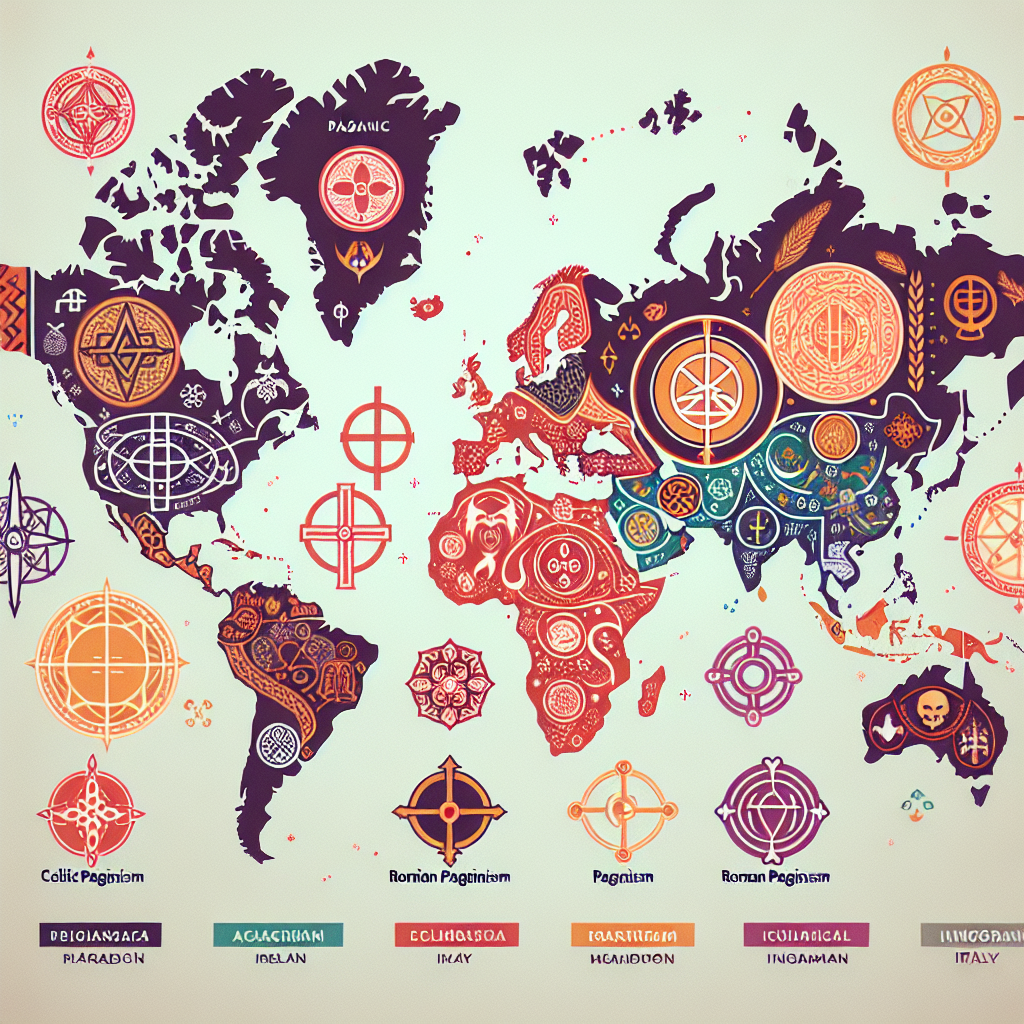
Celtic Paganism and Roman Paganism, while both rooted in ancient traditions, exhibit striking differences in their respective practices, deities, rituals, and societal roles. Celtic Paganism is distinguished by its deep connection to nature, Druidic priesthood, and a pantheon characterized by gods associated with natural elements, introspection, and warfare. Its rituals often involve seasonal festivals like Samhain and Beltane, which are closely tied to agricultural cycles and the spiritual significance of the natural world. In contrast, Roman Paganism is more structured with a well-defined pantheon led by deities like Jupiter and Mars, reflecting the hierarchical and orderly nature of Roman society. Roman religious practices include state-sponsored rituals and ceremonies, such as the Vestal Virgins’ duties, which emphasize civic duty and the well-being of the Roman state.
The cultural influences shaping these Pagan traditions also highlight their differences. Celtic beliefs were orally transmitted, fostering tight-knit community bonds and emphasizing local deities and spirits. Roman Paganism, influenced by Greek religion and philosophy, adopted and adapted gods and practices from conquered territories, leading to a more eclectic and expansive religious system. Where Celtic Paganism’s cultural roots foster a sense of mystery and mysticism, Roman Paganism’s adaptability and legalistic approach offer insights into the empire’s administrative capabilities and imperial unity. Despite these differences, both religious systems richly contribute to our understanding of ancient spirituality, showing how religion can reflect and shape the values and structures of a society.
Amazon and the Amazon logo are trademarks of Amazon.com, Inc, or its affiliates.
Continue Your Magical Journey
Free Witchcraft Starter Kit
Get 6 free printable PDFs: grimoire pages, moon calendar, spells, crystals, herbs, and tarot journal.
We respect your privacy. Unsubscribe anytime.
Enhance Your Practice
As an Amazon Associate, I earn from qualifying purchases.